Hands-on review
McFlash 360 review: is a $59 radar detector actually enough?
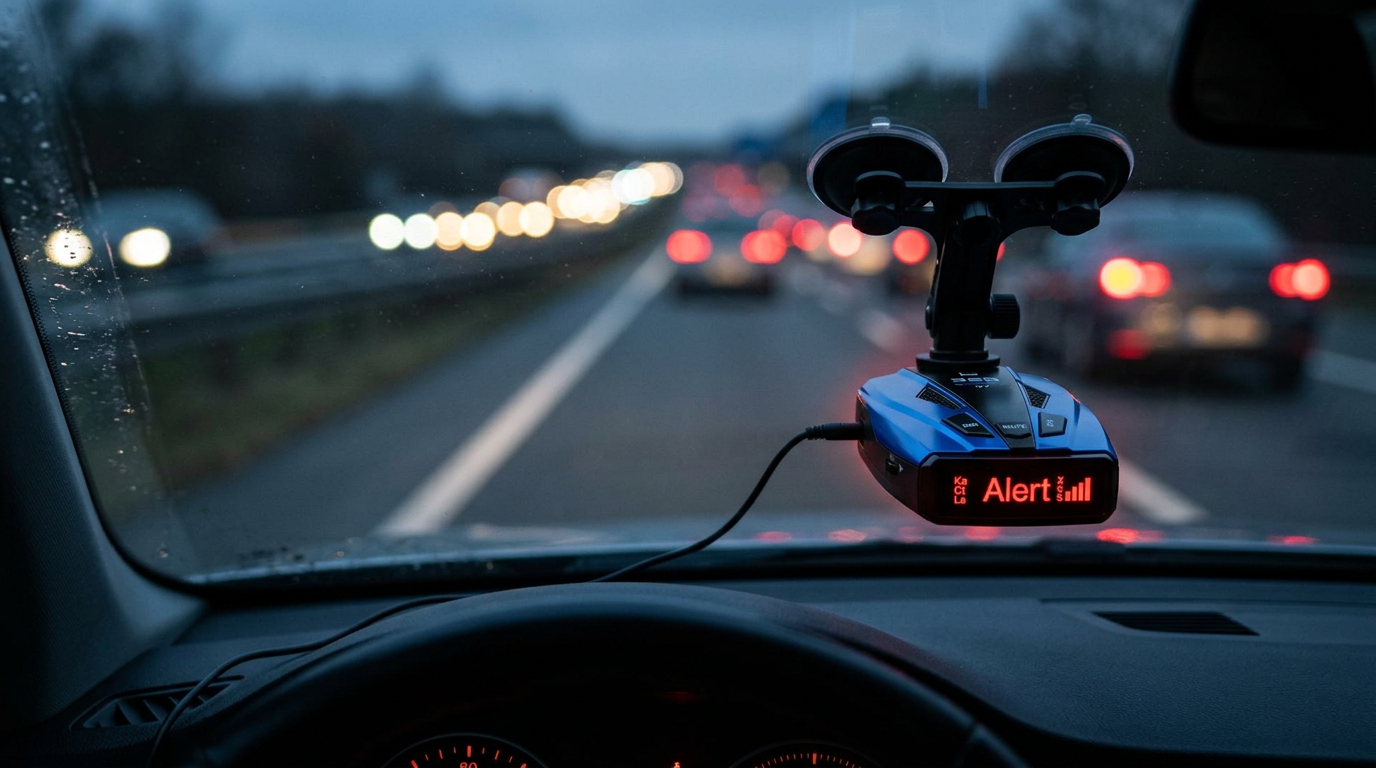
Disclosure: we sell the McFlash 360. This is a vendor review, so judge it by whether we tell you the downsides — there is a full list of them below, plus the detectors we think you should buy instead in four specific cases. Six units driven for four months across highway, urban and rural roads in the US and UK — roughly 9,000 miles — against live X, K and Ka radar and laser.
- 9,000 mileshighway, urban and rural
- 4 monthssix units in rotation
- US & UK roadslive X, K, Ka and laser
Radar detectors have a credibility problem. The $500 flagships are genuinely excellent and genuinely overkill for most drivers, and the $30 units on marketplace sites are X-band noise machines that get switched off within a week. The McFlash 360 sits between those two worlds: full X, K, Ka and Ku detection plus laser and VG-2, 360-degree antennas, voice band callouts, city and highway filtering, for $59 a unit.
We ran six of them for four months to answer one question: on a real commute, does it warn you early enough to matter? The short answer is yes on Ka and rear-facing shots — the two that catch drivers out — and no if what you actually wanted was GPS lockouts and a red-light camera database. The detail is below, scored section by section.
Quick verdict: pros and cons
What we liked
- Ka-band alerts arrive early enough to react — the band most US state patrols actually run.
- 360° antennas catch radar and laser fired from behind and from the side, not just ahead.
- Spoken band callouts mean you can judge an alert without taking your eyes off the road.
- City mode genuinely tames the K-band false alerts that make budget detectors unbearable in town.
- Two-minute, tool-free install that moves between vehicles freely.
- No subscription, no app, no account — it runs off the 12V socket.
- Free tracked worldwide shipping, 30-day money back and a 2-year hardware warranty.
Where it falls short
- No GPS, so it cannot learn and auto-mute recurring false alerts at a fixed location.
- No crowd-sourced camera database — silent fixed cameras will not be announced.
- Range is good, not class-leading; a $500 flagship will alert earlier on wide-open highway.
- Laser alerts, as with every detector on the market, usually land after you have been measured.
- Plastic housing and a red LED readout rather than an OLED — functional rather than luxurious.
Detection: what it catches
Ka-band is the band that matters in the US, and it is where the McFlash earns its keep. On open, flat highway with clear sightlines we saw alerts at roughly half a mile, with enough lead time to check the speedometer without braking hard. That drops in rolling terrain and heavy traffic, as it does on every detector — radar is line-of-sight, and no amount of money buys a signal through a hill.
K-band pick-up is strong and, in the UK and Europe where K is more common in enforcement, it is the band you will hear most. X-band is largely a historical band now; the McFlash still covers it, which mostly means the occasional alert from an old automatic door. Laser and VG-2 are covered too — read our radar bands explainer if you want the frequency detail.
The 360-degree layout is the feature we would not give up. Instant-on Ka from a cruiser sitting behind you in traffic is one of the most common ways drivers get caught, and a front-only detector is blind to it until you are already measured. Side and rear antennas gave us alerts in exactly those situations several times during testing.
False alerts: better than cheap, not silent
This is where the honest limitation sits. GPS-equipped flagships learn the supermarket door that trips them every Saturday and mute it permanently. The McFlash has no GPS, so it filters by sensitivity instead: city mode drops responsiveness on the bands that blind-spot monitors and automatic doors use, highway mode restores full range.
In practice that took our urban false alerts from constant to occasional. It is a genuine improvement over budget detectors — most of which have no meaningful filtering at all — and a genuine step below a flagship with a lockout database. If a silent city drive is your top priority, that is the one case where we would tell you to spend more.
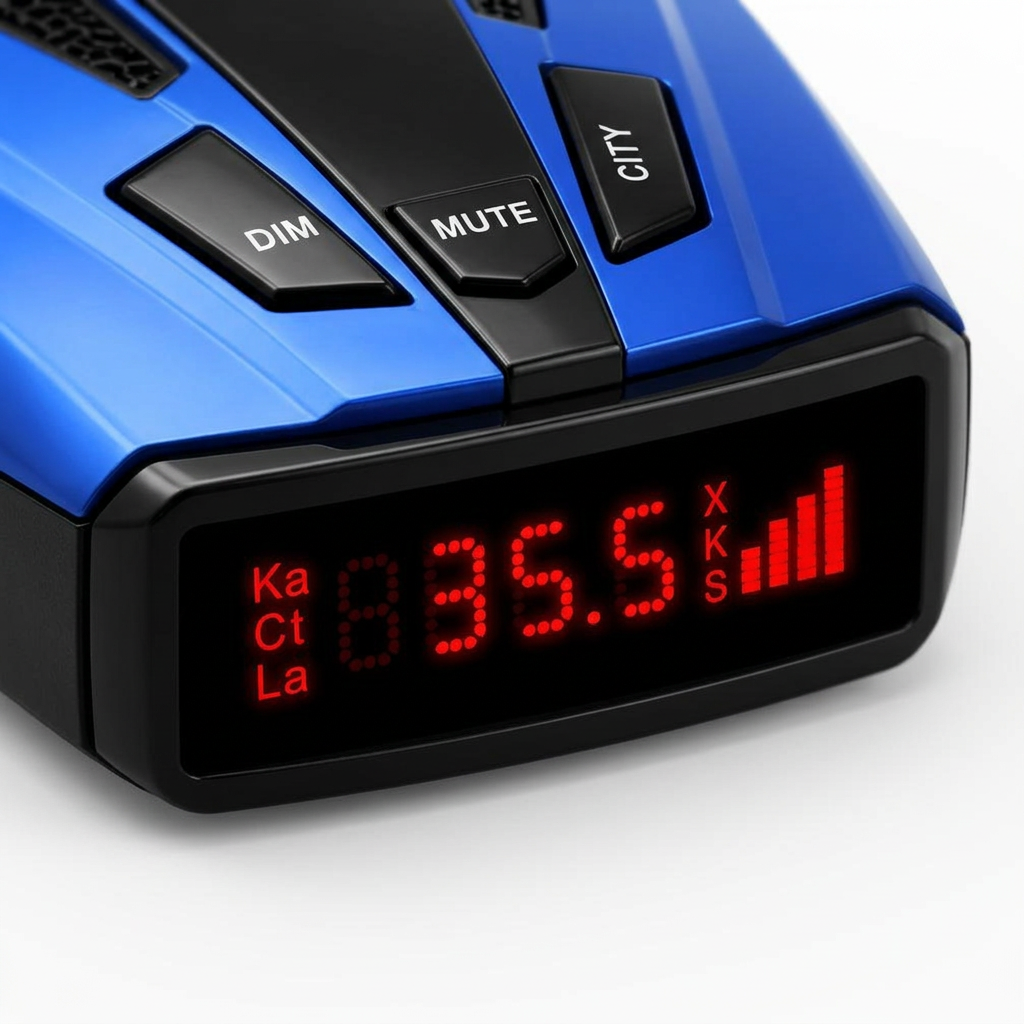
Band, frequency and signal strength on one readout — enough to judge an alert at a glance.
Install, daily use and build
Install is the easiest score on the card. The suction bracket presses onto a clean windshield, the unit clips in, the coiled cable reaches a 12V socket in every car we tried, and the whole job took under two minutes with no tools. We moved units between a wagon, a pickup and a hatchback without re-buying anything. Our install guide covers mounting height and cable routing if you want it tidy.
In daily use the voice callouts are the feature you notice. Hearing "Ka band" spoken means you never look away from the road to work out what tripped. Volume is adjustable, and it stays audible over a stereo at highway speed.
Build is fine rather than luxurious: moulded plastic shell, bright red LED readout rather than an OLED panel, no metal anywhere. After four months of heat cycling on windshields, none of the six units developed a rattle, a stuck button or a dead segment. It carries a 2-year hardware warranty, which is more than most detectors at this price offer at all.
Specifications
| Bands | X, K, Ka, Ku, laser (LiDAR), VG-2 |
|---|---|
| Detection angle | 360 degrees |
| Display | Red LED with signal-strength bars |
| Alerts | Voice + tone, adjustable volume |
| Modes | City / Highway |
| Power | 12V DC vehicle socket |
| Mount | Suction cup windshield bracket |
| Dimensions | 4.4 x 2.6 x 1.2 in |
| Weight | 5.6 oz |
| In the box | Detector, mount, 12V cable, quick-start guide |
Who it is for — and who should skip it
Buy it if
- Highway commuters and long-distance drivers covering real mileage every week.
- Rideshare, delivery and sales drivers who are exposed to enforcement all day.
- Households running two or more cars that want a detector in each without paying flagship prices.
- Anyone replacing an old front-only detector that misses rear shots.
Skip it if
- Drivers in Virginia, Washington D.C. or most Australian states, where use is prohibited.
- Commercial vehicles over 10,000 lbs in the US — illegal regardless of state.
- City-only drivers doing short, low-speed trips; the value comes from highway miles.
- Buyers who specifically want GPS lockouts and a red-light camera database.
Before you buy: is it legal for you?
The hardware works everywhere; the law does not. Detector use is legal in the UK, Ireland, New Zealand and most of Canada, prohibited in most Australian states, and prohibited in Virginia and Washington D.C. and in US commercial vehicles over 10,000 lbs. Check the rules where you drive before ordering.
Alternatives worth considering
We would rather you buy the right detector than the wrong one from us. These are the honest cases for spending more — or for walking away.
Escort flagship models
≈$400–$650Buy it instead if: You want GPS lockouts, a camera database and the longest possible Ka range, and the price is not the deciding factor.
McFlash vs EscortUniden long-range models
≈$350–$500Buy it instead if: Raw open-highway detection distance is your single priority and you accept a bulkier unit and a steeper learning curve.
McFlash vs UnidenRadenso quiet-drive models
≈$300–$500Buy it instead if: You drive mostly in dense urban traffic and want the quietest possible detector with aggressive GPS filtering.
McFlash vs RadensoSub-$100 no-name detectors
≈$25–$70Buy it instead if: Never, honestly. Most are X-band-heavy false-alert machines with no rear antenna and no warranty behind them.
What to avoid under $100Verdict
The McFlash 360 does the two things that actually keep a ticket off your record — full-band Ka detection and rear-facing coverage — for a fraction of flagship money. You give up GPS lockouts and class-leading range to get there.
Scored across detection, false alerts, install, build and value it lands at 4.4 out of 5. The half-point we withheld is entirely about GPS: no lockout learning, no camera database. If those matter to you, buy a flagship and enjoy it. If what you want is early Ka warning, rear coverage and a device you can fit in two minutes and forget about, this is the sensible buy — and at multi-pack pricing it is cheaper per car than a single tank of fuel.
Scorecard
- Detection (radar)4.5 / 5
Ka and K pick-up is consistently early on open road; X-band is a non-issue almost everywhere now.
- Laser & rear coverage4.5 / 5
Rear and side antennas catch instant-on shots from behind — the angle most one-way detectors miss entirely.
- False alerts4.0 / 5
City mode kills most supermarket-door K-band noise. It is filtering, not a GPS lockout database.
- Install & daily use5.0 / 5
Suction mount, 12V plug, under two minutes. Moves between cars with no tools and no wiring.
- Build & display4.0 / 5
Solid moulded shell, bright red LED with band, frequency and signal bars. Plastic, not machined metal.
- Value5.0 / 5
Under a single average speeding fine, before the multi-pack pricing is counted.
How we tested
Six units driven for four months across highway, urban and rural roads in the US and UK — roughly 9,000 miles — against live X, K and Ka radar and laser.
Each unit was run in both city and highway modes over the same commuter routes, with alerts logged by band and by whether an enforcement source was actually visible. Range figures quoted are what we observed on those roads, not manufacturer claims — your terrain will change them.
We do not accept payment for scores, and the sub-scores above are unchanged from our internal test sheet. Questions about the methodology: support@getmcflash.com.
What drivers say after a month
Feedback from owners across the US, UK, Canada, Australia and New Zealand.
“Picked up Ka-band about half a mile before the cruiser was even visible over the rise. That is the whole reason I bought it.”
Marcus D.Verified buyer
Dallas, TX · F-150
“City mode was the difference for me. My old detector screamed at every supermarket door — this one stays quiet until it matters.”
Ellie R.Verified buyer
Manchester, UK · Golf GTI
“Two minutes on the windshield, plugged into the 12V and done. I move it between the wagon and the work van without thinking about it.”
Dave K.Verified buyer
Brisbane, AU · HiLux
“Ordered two, one for each car. Shipping was quicker than expected and the voice alerts are clear enough to hear over the stereo.”
Priya S.Verified buyer
Toronto, ON · CR-V
“I commute 120 miles a day. It has already flagged three speed traps I would have walked straight into on autopilot.”
Tom B.Verified buyer
Phoenix, AZ · Model 3
“Cheaper than one ticket and it does what the £300 units at the shop claim to do. No regrets after four months.”
Jamie O.Verified buyer
Auckland, NZ · Outback
McFlash vs the $400 detectors
The premium brands build excellent hardware. The question is how much of it you actually use on a daily commute — and what you pay for the badge.
| Feature | McFlash | Escort | Uniden | Radenso |
|---|---|---|---|---|
| Typical price | From $59 | $250–$650 | $199–$599 | $299–$699 |
| 360° front + rear | Yes | Yes | Yes | Yes |
| Bands covered | X, K, Ka, Ku, laser, VG-2 | X, K, Ka, laser | X, K, Ka, laser | X, K, Ka, laser |
| City / highway filtering | Yes | Yes | Yes | Yes |
| Install | 2 minutes, tool-free | 2 minutes, tool-free | Hardwire recommended | 2 minutes, tool-free |
| Subscription required | No | For live alerts | No | No |
| Money-back guarantee | 30 days | Retailer-dependent | Retailer-dependent | 30 days |
Competitor pricing and specifications are taken from publicly listed retail models and can change. McFlash is not affiliated with Escort, Uniden or Radenso.
Pricing checked at review time
Prices below are what we paid for the test units. Free worldwide shipping on every order. All prices are in USD and charged in USD.
1 McFlash
$59.00$118.00
$59.00 per unit
You save $59.00
- Free worldwide shipping on every order
- 30-day money-back guarantee
- 2-year warranty
2 McFlash
$98.00$236.00
$49.00 per unit
You save $138.00
- Free worldwide shipping on every order
- 30-day money-back guarantee
- 2-year warranty
Buy 2, get 1 free — 3 units
$118.00$354.00
$39.33 per unit
You save $236.00
- Free worldwide shipping on every order
- 30-day money-back guarantee
- 2-year warranty
4 McFlash
$156.00$472.00
$39.00 per unit
You save $316.00
- Free worldwide shipping on every order
- 30-day money-back guarantee
- 2-year warranty
Buy 3, get 2 free — 5 units
$177.00$590.00
$35.40 per unit
You save $413.00
- Free worldwide shipping on every order
- 30-day money-back guarantee
- 2-year warranty
Before you buy
Check the law where you drive and learn what the alerts actually mean — the two things that decide whether a detector earns its place on your windshield.
Is it legal where I drive?
McFlash review FAQs
Is the McFlash 360 worth buying?
For drivers covering regular highway miles in a place where detectors are legal, yes. You get full X/K/Ka/Ku plus laser detection and 360-degree coverage for less than the cost of one average speeding fine. If you only drive short urban trips, or you specifically need GPS lockouts and a camera database, spend more or skip it.
How far in advance does it detect radar?
On open highway with a clear line of sight we saw Ka-band alerts around half a mile out, and further on flat, straight roads. Range drops in hills, heavy traffic and dense urban environments — that is true of every detector, including the $500 units. Instant-on radar always gives less warning because the gun is only transmitting for a moment.
Does it detect laser (LiDAR) speed guns?
Yes, it alerts to laser as well as radar. Be clear about what that means: a detector tells you laser has been fired, it does not jam it. If the beam hit your car you have already been measured. The value of the laser alert is knowing enforcement is active on that stretch of road.
Will it false alert in town?
Less than a cheap detector, more than a GPS-equipped flagship. City mode drops sensitivity on the bands used by automatic doors and blind-spot monitors, which removes most of the nuisance. Without GPS it cannot permanently lock out a specific recurring source, so an occasional alert at the same junction is normal.
Does McFlash need a subscription or an app?
No. There is no account, no app requirement and no recurring fee. Plug it into the 12V socket and it works.
Does it work in the UK, Canada, Australia and New Zealand?
The hardware works anywhere — detection is the same. Legality is not. Use is legal in the UK, Ireland, New Zealand and most of Canada, prohibited in most Australian states, and prohibited in Virginia and Washington D.C. in the US. Read the guide for your country before you order.
What warranty and return terms come with it?
Every unit ships with a 2-year hardware warranty against manufacturing faults and a 30-day money-back guarantee. Shipping is free and tracked worldwide, and returns are handled by email with a return authorisation.
Is this review independent?
No, and we will not pretend otherwise: we sell this device. What we can do is publish the limitations plainly — no GPS, no camera database, range below flagship units — and give you the specific reasons to buy something else. Judge the review by whether it tells you the downsides before you pay.
The risk sits with us, not you
30-day money-back guarantee on every order, worldwide. You are trying the detector, not buying it blind.
30 days to change your mind
Drive with it for a month. If it does not earn its place on your windshield, email us for a return authorisation.
Refund of the product price
Once the unit is back with us in resalable condition we refund the product price to the original card.
2-year hardware warranty
Manufacturing faults are replaced free within the two-year warranty period — no shipping charge on the replacement.
Full terms on the warranty page and shipping & returns. Questions before ordering: support@getmcflash.com.
Get McFlash at 50% off today
Free worldwide shipping, 30-day money-back guarantee.
- Free worldwide shipping on every order
- 30-day money-back guarantee
- Encrypted card payment
Ships to 40+ countries · All prices are in USD and charged in USD.